Tuesday, July 12, 2011

'One of the tropes of reality TV shows is the promise and tracking of transformation'

In a recent review I wrote about the SBS documentary reality TVseries Go back to where you came from (in on-line magazine The Conversation), I explore whether the 'transformation' of attitudes amongst the six 'characters' is more than an 'unhappy performative'.

 
Individuals might genuinely change their minds as a result of what they’ve experienced, but do the state’s refugee policies change? Sara Ahmed discusses similar questions about  racism/anti-racism in her essay, Declarations of Whiteness: The Non-Performativity of Anti-Racism

There's an interesting response to the series by Klaus Neumann in  Inside Story, 
 30th June 2011.  
Neumann discusses whether 'compassion' can be ‘a motivator for action'. He examines the series in the context of its reception: 'the debate rages on blogs and in the twittersphere rather than on the opinion pages of newspapers'…suggesting that 'the creators of the program have been right in not trying to use the show to campaign for a change of policy, but instead focusing on the paucity of the debate'. Neumann also explores how the emotions aroused by the series, and viewers' 'identification with the six participants, has played a crucial role' in the impact of the series. I agree to some extent,  yet the Gillard Government's (almost) confirmed 'Malaysian Solution' suggests its questionable refugee policies continue apace, despite any intense transformations of heart by onscreen characters in a tightly constructed reality TV series. Developing compassionate government immigration policies remains a major concern. 


Saturday, April 30, 2011

anger is turning to sadness, but future action is not ruled out

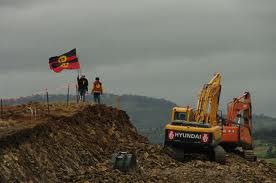
Jim Everett at the kutalayna site, April 2011

Jim's face says it all -  as the Tasmanian Government arrests protestors and proceeds to build the Brighton by-pass over  mumirimina-kutalayna  heritage along the Jordon River;  kutalayna is a significant link to the Tasmanian Aboriginal community’s history of over 40,000 years (see The Tasmanian Aboriginal Centre's (TAC) Draft Report on the Mumirimina People of the Lower Jordan Valley).


"What kind of things I can share with non Aboriginal people so that they can start  to understand that there is a different way of seeing this world... and their identity cannot be Australian with this country until such time as they get here – they will always be bringing the Northern hemisphere down here and constructing a landscape instead of living in country; landscape is just another  image of the colonial construct... whereas connecting to country goes outside of the colonial construct."  Jim Everett.

"There’s No Such Thing As Post-Colonialism". Jim Everett


This month I was pleased to read Will Owen's blog: Aboriginal Art & Culture: an American eye and his thoughtful response to my documentary Island Home Country
Although Island Home Country may have begun as a film about her childhood, Thornley quickly became swept us in the larger questions of history, and then just as quickly in the questions of cultural protocols.  She visits with Jim Everett, with Aunty Phyllis Pitchford, with Tasmanian artists Julie Gough and PennyX Saxon.  Gough in particular raises the issues of image making and image use; Everett and Pitchford urge her to tell her own story and not try to tell the Indigenous stories (although they do contribute their own in snippets throughout the film).  Thus the weave become tangled as Thornley struggles to explore, to learn, and to tell what she learns: to tell a story that is both hers and not hers... She knows as she does so that she is laying a landscape atop country, and knows there is no other way to do it.  It is Jim Everett who speaks the phrase I’ve chosen as the title for this essay: “There’s no such thing as post-colonialism.”  Unless and until the white man leaves and leaves the country to its original inhabitants, whatever remains is still colonial.  There is no escape from history....

Friday, April 15, 2011

save the mumirimina-kutalayna heritage along the Jordon River, Tasmania


Yesterday 15 April 2011 - 25 police arrested 8 camp membersa further 12 people have since been arrested for trepass with no signs of when the conflict will stop. The day before this Jim Everett, respected Tasmanian Aboriginal activist writer, filmmaker, sent an email letter across Australia (and internationally) asking for support to protect this significant Tasmanian Aboriginal site. I post his letter in full and ask all readers to re-post it across their networks. Also visit The Tasmanian Aboriginal Centre's website to learn more about the campaign and give your support.

"Friday 15th April looks like being a very important day in our history and our struggle for respect of who we are, and respect for our culture and heritage. The Tasmanian Government is about to destroy the mumirimina-kutalayna heritage along the Jordon River. Kutalayna holds the Tasmanian Aboriginal community’s history of over 40,000 years. Today, Friday 15th April, our community and our supporters will be at kutalayna to defend our heritage left by our Old People. Constructing a bridge over kutalayna exposes the current Tasmanian Government’s disrespect for our heritage, and our community. Premier Lara Giddings knows that the bridge will destroy the cultural and historical integrity of kutalayna: she dismisses Tasmanian Aboriginal community knowledge about kutalayna boundaries to save 20 seconds of driving time for traffic entering and leaving Hobart. Premier Giddings has a reasonable option to re-route the bypass over the existing bridge to the north, and along and around kutalayna.

Over 40,000 years of Tasmanian Aboriginal heritage, a unique record of human experiences covering at least 2 Ice-ages, is about to be seriously interfered with. Yet we continue Our Struggle for respect and rights inherent in who we are. This has serious consequences for our community. We believe that the police will arrive today to order supporters away from the kutalayna camp, or arrest the people who refuse to leave: supporters and ‘activists’ standing strong as one body to defend kutalayna. Our action will be a passive and send a clear message to the Government that our heritage is not a bargaining tool. Promises of replacing the out-dated Aboriginal Relics Act 1975 with stronger protection laws of our heritage can’t seriously be considered a bargain for agreeing to the destruction of our heritage. Kutalayna, is our oldest ‘library’ book, it holds the stories of our Old People going back over 40,000 years. Our community has suffered many years of destruction to our heritage since Invasion Day: we must make a stand now, leaving it to our grand-children, and theirs’, must not be allowed to happen.

The issue in focus at kutalayna brings a strong opportunity for developing better relationships between the Tasmanian Aboriginal community and white-Tasmania. To make this happen, a genuine demonstration of meaningful progress in respecting our culture and heritage must be shown by the Tasmanian Government.

I know that we all have hoped that after all of the many years we have struggled to be acknowledged as the contemporary Tasmanian Aboriginal Community; with our objective to be genuinely respected for who we are, and with respect of our rights as Aboriginal people: and, after significant agreements have been achieved with previous Tasmanian Governments: our hope has been that we would not again be forced to to protect our heritage from destruction by a Tasmanian Government. The progress we have achieved in relationships between white-Tasmania and our community, encouraged by previous Tasmanian Governments, is being trashed by Premier Giddings’ Government. Whatever active part you play now, urgently, to increase pressure on the Government to stop the threats to kutalayna, may open some positive outcome for our community.

To be short, we are demanding respect by all of Tasmania, represented by the Tasmanian Government, of our rights concerning the protection of our heritage. I ask you to encourage others to come to the kutalayna camp and show support in saving our heritage from this pending threat."


Saturday, December 11, 2010

‘the shock of the feminist’


The omission of women from the cultural record meant the search for a women’s tradition

I came across this article a few months back: "Wonders Taken for Signs: The Cultural Activism of the Australian Women’s Movement as Avant-Garde Reformation" by Margaret Henderson ( Lilith 17: 2008). It's a very thoughtful discussion of feminism and cultural production and what we can learn from that intense period of the "1970s and 1980s, in Australia and throughout the West, (when) relations of cultural production, reception, and texts (and films) all worked together to create the ‘shock of the feminist’". In her essay Henderson also discusses the "collective, as (the) defining structure of the women’s movement, signifier par excellence of its cultural politics"; here she also refers to various women's collectives including the Sydney Women's Film Group - which I became a member of in 1969:
Collectivism, as a strategy to demystify artistic production, to challenge the bourgeois artist figure and ideology of individualism, and to overcome women’s isolation, is the creative ethos powering feminist culture, whether in textual production or distribution. In the case of film, the auteur theory was rejected in favour of a non-hierarchical collective structure of film making, ‘one in which all the creative and technical roles were shared among the group’.

There's a longer essay to be written which explores the rise and fall (and rise) of 'the collective' in women's film-making; food for thought as a group of younger feminists contacted the For Love or Money (A history of women and work in Australia, feature documentary and Penguin Book 1983) team recently as they produce a short film on the history of International Women's Day. Younger women are discovering that the 'post-feminist' era is not necessarily a place of liberation! We did, after all call our movement Women's Liberation! Another group of young feminists saw For Love or Money at an IWD screening at their uni last year: "Last night, I watched the feminist documentary ‘For Love or Money’ at my university...As I sat there, waiting for the sense of relief and liberation to wash over me, I suddenly realized that every injustice suffered by our foremothers still exists today – it’s just dressed differently." ( Zoya Patel, 'Get Outraged!' in lip magazine, March 2010).

It's worth thinking and acting on this too: that our early film works of the 1970s and 1980s were all produced prior to Web 2.0. We have much to do to give these historically significant films presence in the 21st century.

Monday, August 2, 2010

Oprah’s generosity is a smoke screen


Oprah’s generosity is a smoke screen. Given her audiences are predominately women I am concerned by my gender’s complicity in this government PR campaign. Worth examining is Oprah’s gift of 6000 Kimberley Coast pearl necklaces to Australian audiences. Several family-work visits to the Kimberley this year have revealed to me the huge social and environmental issues facing people here. Most stark are housing, health and educational issues for Aboriginal people. Many struggling ‘settler’ Australians also face a housing crisis and rapidly rising rents. As well, myriad issues around energy company Woodside’s gas project, north of Broome, needs an informed local and national polity to cut through the ‘environmental’ versus ‘development’ split.

Sadly Oprah’s circus, in tandem with a misguided Federal government, is ‘pulling the wool’ over the eyes of the woman in the street. Australian women, try not to be bought off by these ‘pearls’! Investigate the gas hub debate; research the history of the pearling industry in Broome; examine Indigenous infant mortality across northern Australia. Perhaps then you may consider donating your pearls to Aboriginal medical centres and schools in the Kimberley where your gift will be more than decorative.

Wednesday, July 7, 2010

on the road

On the road, staying in Halls Creek. I have just finished reading Alexis Wright's Grog War. She describes it as:
The book that I wrote for the people, the Aboriginal people in Tennant Creek, the Warramunga people. 'Grog War', it is a book that they asked me to do to document 10 years of an enormous struggle that they had to introduce some pretty, I don't think they were major restrictions, simple restrictions to the availability of alcohol in Tennant Creek and they took 10 years just to bring in some restrictions in that town and they had to fight every inch of the way.


KERRY O'BRIEN: You wrote in 'Grog War' Aboriginal people are still being forced to hold much of their contact with white people locked away inside of themselves. The best parallel which describes that hidden history is describe that it's trapped like angry hornets inside Pandora's box. Those words must still resonate with you?

ALEXIS WRIGHT: Well, they do. If we expose our anger, sometimes if we express our anger we're criticised for being too emotional or too angry.


KERRY O'BRIEN: After 'Carpentaria' and with Aboriginal, Chinese and Irish blood in your veins you reflected on what might constitute a lasting form of reconciliation.


You wrote, "I've often thought about how the spirits of other countries have followed their people to Australia, and how those spirits might be reconciled with the ancestral spirits that belong here. I wonder if it is at this level of thinking that lasting form of reconciliation between people might begin, and if not, how our spirits will react."

It is very soft and very hard out here....both at the same time.

Tuesday, April 6, 2010

Apache helicopter gun-sight video

5th April 2010 10:44 EST WikiLeaks  released classified US military video depicting the indiscriminate slaying of over a dozen people in the Iraqi suburb of New Baghdad -- including two Reuters news staff.


http://news.ycombinator.com/item?id=1241879

Monday, January 11, 2010

"I began to experience a strange tension with my technology".


Walking with Kabir by Shabnam Virmani: " As I ventured into the life of Kabir in the community, I began to experience a strange tension with my technology. The presence of my camera seemed to separate me from the action and relegate me to being a passive observer...Being part of the making process seemed more vital and important than consuming what is made, in my case, ‘recording’ it. It seemed imperative to be fully enveloped in the live pulsating music, to allow it to infiltrate your very pores and have the poetry literally enter your body by singing it...Our middle class lives deliver to us mediated experiences that come to us through books, TV, radio, music CDs and the internet — technology that can certainly deliver powerful experiences, but that can also circumscribe our lives, cut it off from immersion in a vital life force that exists in nature, in the tactile experience of sound, music and earth. We get alienated, we become watchers of spectacles, far-removed, we become phlegmatic, we don’t participate... What I realized in that moment was that in some sense, these were not my films at all. They were not something I made or earned or chose. They were experiences I received as gifts, from a space that lay beyond the claims of my small self. All I had to do now was to pass them on and gift them to others:

Meraa mujh mein kuchch naheen
Jo kuchch hai so teraa
Teraa tujh ko saunp dun
Kyaa laage hai meraa?
There is nothing in me that’s mine
All that is — is yours
I offer to you what’s already yours
What can I say is mine?"


Article by Shabnam Virmani January 2010 Seminar magazine based on a talk she gave in October 2010. View Shabnam's talk and singing here:

Shabnam Virmani is a filmmaker and artist in residence at the Srishti School of Art, Design and Technology in Bangalore, India. 7 years ago she started travelling with folk singers in Malwa, Rajasthan and Pakistan in a quest for the spiritual and socio-political resonances of the 15th century mystic poet Kabir in our contemporary worlds. Her documentary Koi Sunta Hai: Journeys with Kumar & Kabir can be watched online at Culture Unplugged

I recommend her work to you. It is profound.

Sunday, November 29, 2009

tayenebe and meditation on a photograph


I am coming across a range of links to the Oyster Cove photographs by Nixon and representation; yet both unsatisfying - neither of them approaching nearby the heart of the matter. At least the The Representation Of Trucanini essay acknowledges the subjectivity of the photographer or the observor: "It is clear that no archival photograph of the Tasmanian Aborigine can be viewed as a document of truth, as the decisions of the photographer inadvertently affects the way in which the subjects were represented" . But how in 2009 can this writer place his whole study within the 'doomed race' theory of Tasmanian history! It's incredible. Just visit tayenebefor the living dynamic presence of the culture of Tasmanian Aboriginal people today.

Bishop Nixon's photograph of the Elders at Oyster Cove (1858) haunts me. It always has – from the moment I first saw it in 1982 in the State Library of Tasmania collection. The photograph is a ‘trace’ of the real. But, I am white and I have obtained a copy of it, and now I carry it around – slowly becoming aware of the ethics involved in having it in my possession; There is no return back to some fantasy of Tasmania as a ‘good’ white place. Sitting with this photograph, with the survivors of invasion, I look at the hands of the women, the comfort of their physical closeness to each other and their dogs. As the camera apparatus captures their image on silver nitrate for me to gaze at them – they look back at me – and for this moment, as observer, I stand in photographer Nixon’s place . I am his camera. I look at the women – Emma, Trucanini, Flora, Wapperty. They look back at me. I know it is their country. They belong to this island. Dispossessed by the British, yet the photograph speaks their possession.

This is a photo of their sovereignty of their own country. I allow this photo to possess me back. The women, their dogs – their gaze at me – is grounded, strong: ‘this is our country, back off, you stranger – white ghost’. They speak to me, not in words, but they affect me. I dream of them, at night. I see them as I walk the streets of Hobart. Their spirit is there, whispering to me to reckon with their presence. They are not gone, as the British hoped, as most of the whites in Tasmania hoped, that they would be gone forever. No, I ‘let them come visit. I allow myself to be haunted and, as I do, I sense myself as the stranger: ‘making whiteness strange’ and the risks involved. I am the interloper. Once, this island felt like home, but now I am in another country – strangeness, dislocation. I do not belong to this nation called Australia. This nation is a Thing, a fantasy space. The Oyster Cove photograph disturbs; it is a kernel of The Real.

tayenebe is now; tayenebe makers discuss their work today.

Monday, July 13, 2009

documentary modes


It is documentary film theorist Bill Nichols who writes about the chief characteristics and deficiencies of each documentary mode (Introduction to Documentary (2001:139). It was interesting, then, this morning to read Cynthia Lucia's interview with the filmmaker of Dogora, Patrice Leconte in Cineaste: "Personal Politics and Vision in Dogora: An Interview with Patrice Leconte". Now, Leconte is not really a documentary filmmaker, nor has he read any documentary film studies (most documentary filmmakers haven't). In the interview I can sense how he is struggling over the shortcomings of the mode(s) he chose for this film:

Lucia writes: Yet, as is true of certain moments in Wiseman’s work, at points in Dogora the absence of information not only impedes viewer comprehension, but it also potentially inhibits active or, at best, activist viewer response. The footage centered on the Steung Mean Chey garbage dump—the largest open landfill in Asia, located a half hour outside Phnom Penh City—is a case in point. We see impoverished adults and children collecting waste (and sometimes consuming something edible they may find) through day and night. We also see images of children studying and sleeping in a schoolroom. It’s difficult to make sense of these images—what they mean or how they are connected. In the French DVD release of the film, Leconte, on the commentary track, explains that the school is run by PSE (Pour un Sourire d’Enfant [For a Child’s Smile]), a French organization devoted to helping the children, many of whom are orphans, obtain an education and the basic necessities of life. At the time of filming, Christian des Pallieres oversaw the school and the charitable work involving landfill residents. While the images evoke a powerful emotional response, one wonders if a bit more information might elicit something more substantial—whether through further research, donations, or other support of landfill workers. At the same time, of course, that could easily tip the film’s balance away from the lyrical to a more didactic, public-service mode—and that, too, would present a problem.. Lucia writes of a 'fissure—between the personal, lyrical project of the film and those disquieting images that seem to press for something more'.

Sunday, July 12, 2009

Oyster Cove, Tasmania, photography and Bishop Nixon 1858


"The fact that Nixon saw art as a means of recording may explain why he was one of the first people in Tasmania to experiment with the newly invented camera.... About 1858 he visited Oyster Cove and made several photographs - the earliest known - of the Aboriginal community" (SLTAS website). In Island Home Country (2008) , my recent documentary film, there is a discussion around the ethics concerning the use of these photographs.

Nixon's work as a photographer is little researched. I am gathering material on his work. Please post any links you may find. Here is one I have recently located: Thomas J. Nevin, Tasmanian photographer 1842- 1923.

Martha of the North


I haven't seen Martha’s film yet, only the trailer. I have ordered the film for UTS library. But have a look at this clip here: Mary May Simon, a dynamic activist for her people, former Canadian diplomat, Fellow of the Arctic Institute of North America, introduces Martha Flaherty's film Martha of the North at its launch in this year in Ottawa. In this intro I think she acknowledges that Martha’s father Josephie Flaherty, (Flaherty’s Inuit son), is in the audience. I am not sure: watch this clip! Also today I learned of a 1990 documentary, Nanook Revisted which revisits the site of Flaherty’s filming. Here too is a wiki on Nanook Revisted that furthers discussions around these complex issues in documentary


Saturday, July 11, 2009

Robert Flaherty's Secret


It seemed ironic that the global popularity of “Nanook”, had served to freeze the Arctic and the people who live in it, including Robert’s (Flaherty) own son and granddaughter, in a version of a past that never was, in a land that could never be.’ (The Long Exile by Melanie McGrath, 2006).
After reading The Long Exile - a tale of the betrayal of the Inuit people – in their 1950s relocation to barren islands far away from their homelands, I found Martha Flaherty's email address and wrote to her. In my mind the relocations and subsequent struggles for justice by the Inuit people cry out for a broad contextualising of Flaherty's 1922 documentary Nanook of the North, from its time of production right up to the present. Martha Flaherty wrote back and told me about a new film about her life, Martha of the North and how she is planning a book about the true story of what happened during the relocations. I have been very touched by this correspondence and how it contributes depth of understanding around the complex site of documentary film-making process and ethics.
One of the exiles was Robert Flaherty's son- Josephie Flaherty - a child he had (and abandoned?) with Inuit woman, Maggie Nujarlutuk (who plays Nyla in Nanook of the North). The story of Flaherty's relationship with Maggie (and his son) is never told in the documentary film scholarship (or rhetoric) of Flaherty's film-making - so obsessed is it with textual analysis and 'the past' and whether the dramatizations are ‘documentary’ or 'ethnographic'. Such debates may be functioning as smoke screen to developing a contextual analysis that really changes the way we think about Flaherty and his film. Martha Flaherty's documentary (and for me also McGrath's book) opens up present day realities of the Inuit people and the role Nanook of the North played in forming a certain idealized and heroic narrative of the Inuit people that fed into racist stereotypes - which contributed to the disastrous relocations of the Inuit people in the 1950s.


Saturday, June 27, 2009

the disobedient reader...viewer


Why an image from Sunless? Well, a blog on Sebald, Vertigo: Collecting& Reading W.G. Sebald, compares Marker and Sebald.
This site also reviews Australian author Deane Blackler's book, “Reading W.G. Sebald: Adventure and Disobedience”. I have found her analysis of Sebald's narrator persona insightful. She looks at how we read Sebald and argues that his books call forth a proactive reader: one who is challenged to question the text by his use of seemingly documentary photographs, the pseudo-autobiographical narrators.

In Island Home Country I peer into my own ‘white’ mind, and create a narrator – a staged performance – of white instability, uncertainty, fissure. As Blackler reflects in her study of W.G. Sebald ‘how can the reader trust this mad writer narrator as a guide'… as in this film, I create a narrator who is ‘trying’ to make a film, a filmmaker who ‘forgets to turn on the microphone’, a narrator who says, ‘this film is dissolving’; a narrator who loses her way. ‘Where is the reader to go? If we follow a ‘mad’ narrator, won’t we be implicated in (her) pathology?….This self-conscious writer, this constructed ‘I’ is not a stable authorial figure. Blackler argues that this unstable, figure gives birth to a ‘disobedient reader’, one who has to break ranks, cross an unstable line, in order to stay empathic.

Saturday, January 10, 2009

Island Home Country- Current news 2009

Distribution of Island Home Country: where to purchase DVD's, & the recently published ATOM Study Guide. Island Home Country is a poetic cine-essay (52 mins) about Australia’s colonised history and how it impacts into the present. It offers insights into how various individuals reckon with the traumatic legacies of British colonialism and its race based policies.

Island Home Country was recently offered a broadcast contract with National ABC Television: Sunday Arts Program July 2009.
Screenings:
TAC International Film and Video Festival, Oregon USA May 2009.
Premiered at Brisbane International Film Festival August 2008.
Screened in the Film Program, 'Re-Orienting Whiteness' Conference (Monash University) December, 2008.
Awards
Nominated: Best Achievement in Sound for a Documentary, Australian Screen Sound Awards 2008. (Sound Designer Sharon Jakovsky; Sound Consultant Danielle Weissner).
High Commendation - UTS Reconciliation Award, UTS Human Rights Awards, October 2008.

The Island Home Country ATOM Study Guide is now available a free PDF from Metro ATOM (Australian Teachers of Media)

Purchase DVD's direct from Anandi Films or
The Education Shop

Friday, September 19, 2008

Video: Launch of James Boyce's Van Diemen's Land


Tasmanian author and commentator Richard Flanagan launched James Boyce's Van Diemen's Land - a new, groundbreaking history of the settlement of Tasmania - at the North Fitzroy Star in February 2008.

Friday, September 5, 2008

Three Rooms of Melancholia

This week in a Seminar on Constructing the Nation I screened a montage from the opening Ceremony of the Beijing Olympic Games; a clip from Obama's Democratic Acceptance Speech and a clip from Three Rooms of Melancholia. For me Honkasalo's haunting film enters into a space which explores the traumatic consequences of militaristic nationalism. With Sarah Palan's furies unfurling across the political landscape - we need more than ever the poet's mind and eye. Thankyou Pirjo for your contemplative, thoughtful film - ultimately a film about the need for tenderness.

Pirjo Honkasalo's director's statement:
Having completed my 'Trilogy of the Sacred and Satanic”(the full-length documentary films Mysterion, Tanjuska and the 7 Devils, and Atman), I felt I had purged myself of what I had sought from the documentary film: its purifying and implacable concreteness. I had given whatever I had to give; to that concretion, an intimation of human silence.
I felt an attraction and attachment to the logic of the dream, to which the fictional film provides the most natural path. The world of the dream is half in the past, half in the future. Its gods swing back and forth between life and death. There is no sense of longing in dreams. Time in dreams is not time in time. I directed the feature film “Fire-Eater”. I have always been stimulated not only by the Sacred and Satanic, but also by the Poetic and Political. It was this that drew me back to the documentary. I don't care for truths, for I see all thought as roiling foam that adheres to nothing nor holds fast; but in the time when I am not asleep or dreaming, I wish to know how the human tribe leads its life, shapes its history and expresses its will, which always seeks to improve the human condition and yet wallows, bewildered, in its blood like some elk gone astray in the city and impaled on the spikes of a cemetery fence. It should not happen this way.
Europe is filled with people who need grace of some kind to cope with their righteous rage. The righteous rage turns, a reflection, against them. And life is no court of justice; justice does not prevail, life does. It rises out of chaos in an ascending spiral, briefly appears to have structure, and descends in the curve of a downward spiral toward fresh chaos.
Stripping away icons of the enemy calls for the acceptance of grace along with righteousness. Grace is illogical and irrational - in other words, a profoundly gratuitous liberation from the compulsion to hate.

Tuesday, July 29, 2008

island home country


I started to wake up to race in the 60s. We’d gone, us anthropology students, to build transitional houses for the Pitjantjatjara people…I went with my best friend Moni. I filmed with her for this film. Going to the Pitjantjatjara Lands was a life changing experience for both of us and I asked her to talk about her memories of this Abschol (Aboriginal Scholarships) Work Camp.

Moni
You go to a foreign country and that’s what it was, Central Australia, the Aboriginal Reserve. It was just a trip into a completely unknown world. And at that time, in that nineteen or twenty year old head it was just, just responding to the situation in terms of a strange experience. Strange in the sense that it’s unfamiliar.The most powerful one of almost an identity crisis was that toilet incident - where you and I went to look for a toilet, just outside Coober Pedy. It’s so Australian, a town with one pub and in that pub was two toilets, one for blacks and one for whites, obviously. And I stood between that, ‘cause I’m neither black nor white.

Thursday, June 19, 2008

amnesia

An effect of amnesia is the inability to imagine the future.

strange, I meditate to try and be in the present and stop worrying about the future.....in any case here is Chapter 1 Menu design for the film Island Home Country. Thank you Tim Baines - graphic designer - for all your work these past few weeks. Making a DVD is like making another film!

Saturday, May 31, 2008

Maidens an autobiographical essay film (1978)

A clip from Maidens


In a way making Island Home Country has been a revisiting of both Maidens and Tasmania, growing up, as I did, in the repressive era of the 1940s-1950s on that island. Returning to Tasmania in 2004 to make this film I began to excavate into the hard crust of my early childhood memories of a peaceful island with the reality of colonisation and the attempted genocide of the island peoples. When I made Maidens I had no idea of colonisation and 'what had really happened'. I lived in an all 'white world'. The Island Home Country project was conceived amidst the bitter time of ‘the history wars’ as ‘a work of mourning’, utilising psychoanalysis to make some kind of reckoning with history. I was interested in the relevance of the Mitscherlich’s research on post war Germans and their seeming total repression of Germany’s painful past straight after the war. As well I wanted to explore the kinds of amnesia represented in both my upbringing and in my films. As Christopher Koch (1987) writes in Crossing the Gap: A Novelist’s Essay, "we who lived (in Tasmania) between the thirties and the fifties were living in the half-light of a dying British Empire; but we only slowly came to realise it. The culture based in London was the imaginary pole star of our world. "

Sunday, May 25, 2008

The Visual Representation of Developing Countries

Bangladeshi photographer Shahidul Alam wrote this essay The Visual Representation of Developing Countries by Developmental Agencies and the Western Media in May 1994. But it's still relevant in 2008.

Download This: The Future of Distribution is Just a Click Away


The future, and this present moment of documentary distribution- on line and the role of the traditional educational distributors is discussed in this article in independent, the new on line Independent Film & Video Monthly. This is a timely article as I look at the distribution choices I have for Island Home Country. To be continued....

Wednesday, April 30, 2008

remembering, repeating, working through

We finished the film last night. Assistant editor Andrew Corsi and I working through this last (almost) year to bring this project to completion, a project that began in 2004. Karen Pearlman joined me as editor in 2005. I keep Karen's text on my mobile: when she got my 4 hour assembly (from 40 hours). She texted: A cut is born - 90mins 35sec and 15 frames. Karen delivered picture lock off (52mins)last June 07 and due, in part, to the film's commitment and responsibility to the the Tasmanian Aboriginal Protocols process, Andrew and I have taken almost a year to make the required changes and to then complete the online work. Sharon Jakovsky completed the final mix two weeks ago; So many people to thank - but a special thank you right now is due to Sarah Gibson (script and project consultant), Toula Anastas (production supervisor), Megan McMurchy (consultant producer), my whole extended family, especially Stephen Ginsborg and of course all those who appear in the film: my sister Jan Thornley, Auntie Merle Archer, Cousin Leigh Archer, Aunty Phyllis Pitchford – nunarng, Jim Everett - puralia meenamatta, Julie Gough, Penny X Saxon, Clive Atkinson, Moni Lai Storz, Dur-e Dara, Julie Janson, Anthony Bell, Rinki Bhattacharya and Arundhati Roy.
And here is a 3 min quicktime (Thanks Andrew.) It is from a sequence of the film about private memory and public memory and the fluid movement between the two. I have called the clip remembering, repeating, working through after Freud's 1914 essay. Also the film, for me, is about this process of remembering the past and working it through - both personally and in the public arena. The 2008 Apology is perhaps the most recent example of historical memory enacting and reverberating through our lives in so many ways. Yet, as Noel Pearson says in When Words Aren't Enough, "Blackfellas will get the words, the whitefellas will keep the money. And by Thursday the Stolen Generations and their apology will be over as a political issue."

Wednesday, April 23, 2008

Australia's Sacred Sites Anzac Day - my pa


Dear Pa,
I am writing this letter to you on Anzac Day eve. Here you are as a young Anzac and this is my narration in an Anzac sequence in my current documentary ISLAND HOME COUNTRY. I am writing to ask your permission to use the photo in the film along with this narration: Here’s some film I shot of white Australia’s national day of mourning - where we remember the dead - fallen in World War 1 at Gallipoli. The old diggers remind me of our Pa. The World War 1 gunner, dying of mustard gas poisoning in his sick bed. A historian says Australia can mourn these soldiers, but what about the Aboriginal warriors who fought for country when the British invaded? Can they be mourned by the nation as well?
The historian I am referring to is Henry Reynolds. I like the way he opens the map to include the colonial war fought between the British and the First Australians as a war we must commemorate too. And that it is important to move beyond Britain and Germany's war, a war we sent our service men to with such blind obedience to Mother England. Here Reynolds talks about these wars, these events we mourn and make monuments to ( or not) , with Rachel Khon and Ken Inglis on The Spirit of Things, ABC 2001.
Henry Reynolds: If we make the centrepiece of our celebration, our invasion of Turkey, a country we knew nothing about and had no direct experience with, I can’t see why we can’t come to terms with our invasion of Australia.

But more than ever before, Pa, I can hold the memory of you and honour your life and what you suffered in the trenches of World War 1. You were a kind and loving grandfather to us all. I think I felt something of the pain you carried from that war, even when I was a child at Invermay at your and Nan's house.
I am thinking of you,
your loving grand daughter, Jeni.

Sunday, March 16, 2008

me and mr greenaway

The frame is from Island Home Country. The text - a quote from David Tiley at AIDC 08 on Greenaway's plenary at the Conference. I, didn't go, of course. No money and at the beginning of the fifth year of making a film that defies completion....how to explain this rabbit hole I am down? Who would understand? I can't.

"He is also unimpressed with the documentary tradition, which he calls “false and phony – this desire to tell the truth, the truth is untellable.” We create subjective, individual truths; to assert they are more is “an act of extreme arrogance. I would rather advertise and proselytize myself as a liar in order to be able to tell you the truth of those lies than the opposite way round.”

“I’m duty bound I think as a self conscious filmmaker to always tell you that when you are watching one of my films that you are just watching a film. You are not looking through a window on the world. I’m giving you a film. An extraordinary vocabulary and language which is deeply, deeply artificial.” Peter Greenaway

Saturday, March 15, 2008

The end of empire: Jarman, Swinton and "pre-industrial filmmaking."

Isaac Julien and Tilda Swinton, at the filmmaker's grave. Julien has curated a retrospective on Jarman. Photo Nina Kellgren.
On August 17, 2002, eight years after Jarman's death, Tilda Swinton, published an epistle to  Jarman entitled Letter to an Angel:
 Derek made filmmakers out of all of us who worked with him. Our work came out of the pre-industrial atmosphere of an art context, not the segregated professionalism of industrial filmmaking. This is the atmosphere I carry with me everywhere, like an amniotic sac.  It is the only way I know to work.
Well, some call her essay a lament for a lost era, yet I love the way she keeps it alive in her mind and the way it influences how she thinks and works today. A thinker, is Swinton.

Friday, March 14, 2008

navigating jonas mekas


Immersed in links to international distribution of documentaries - in this era of multi platforms - traditional and new paradigms circling each other...and I stumbled on Jonas Mekas's site: what a find! And then STREAM.

Monday, March 10, 2008

documentary: A Letter to a Boy from His Mother

documentary: A Letter to a Boy from His Mother

why Jonathon..I was so happy to get a response to my blog - so thanks for that (it hardly ever gets a response;  my daughter says: "well Mum, it's because it's so boring like your films." ) And then, the only response I get from you is navigational advice for the poor user who doesn't realise that the link is always in the header of each post I write! I must say I'm more interested in what you think of Tilda's essay than navigational advice...maybe it was irony.....By the way, what do you feel about Tilda's essay?

Sunday, March 9, 2008

A Letter to a Boy from His Mother

Boy , my darling is how Tilda Swinton starts her beautiful essay on cinema and dreams and possibility and ethics : You asked me the other day, just as you were dropping off, what people’s dreams were like before the cinema was invented. You who talk blabberish and chase rabbits in your sleep, hurrumphing like a dog..you who never watch television..I’ve been thinking of your question ever since. I need to print her essay out and read it slowly, savouring each word as this actor/writer/cultural activist speaks in a voice little heard in the speed of the age, in the age of speed. 
Tilda Swinton’s State of Cinema address, San Francisco, 2006. First published in Critical Quarterly, vol.48, no.4. Now in Vertigo