Showing posts with label living beyond the colonial construct. Show all posts

Tuesday, August 31, 2021

"For Love or Money" IWD Avoca Cinema 2013

"Thank you it is a real pleasure to be here and introduce For Love or Money. 


I would like to show my respect and acknowledge the Traditional Custodians of the Land, the Darkinjung, their Elders past and present on which this special Avoca Cinema IWD event is taking place.

Lyndall Ryan  asked if I could say a few words about the making of the film, its purpose as a feminist film and how it stands today... and I hope Lyndall will also say a few words to on how the film fares today!

So firstly I would like to acknowledge my collaborators,  Megan McMurchy, Margot Nash, Margot Oliver and Lyndall (who was the historical consultant on our Penguin tie-in book); also Lyndall’s mother Edna Ryan – feminist activist and labour historian who is interviewed in the film, and whose analysis contributes much to the film’s economic analysis of women’s position.

Really, the purpose of the film was to create a visual, moving story about Australian women’s campaigns for wage justice and gender equality – campaigns for a just society, a civil society.


And we also wanted to make a film that interrogated and subverted the representation of women in Australian cinema. In the 70s there were few female film directors. The depiction of women tended to place women in passive, subservient roles. The daily experiences of ‘real women’ in the work place or at home were ignored.


Making the film
Ours was a spirited and long collaborative six year process - beginning with the 1978 Women and Labour Conference; the groundbreaking work of feminist historians was tumbling out in print form: books, articles – but there was no film that documented Australian women and work with any historical perspective or economic analysis, or that documented women’s radical activism to achieve, the vote, equal pay, property rights, legal abortion and child care.

We began our work in the archives - National Film and Sound Archive. Megan and I saw almost every Australian documentary and feature film produced - and we analysed every film from the perspective of how it represented women - selecting sequences to create the film. Meanwhile Margot Oliver joined us, and with a socialist feminist labour history perspective, starting recording interviews with women across Australia. The impulse was to seek out activist women, like Zelda D’Aprano, Edna Ryan and many others, like the great Aboriginal activist Pearl Gibbs.


Margot Nash joined us as the film's editor and Elizabeth Drake came on board as composer.  We recorded over 35 interviews (film and audio),  printed footage from our selected archival film and photographic collections, did extensive manuscript research and wrote many versions of the script and narration! Through all this was raising the budget to make the film. See the end credits and you will get a sense of scale.

How is the film relevant to today?
Well, first, let’s consider local IWD’s 2013 demands:
• stop violence against women
• end breastfeeding discrimination
• affordable childcare
• ratify the migrant workers' convention

And from one spectrum to the other:  In the board room only 5% of CEO’s are women. And in many Aboriginal communities the position of women is totally vulnerable due to both endemic historical racism – white privilege creating exclusionary work place practices; add to that the complexities of domestic violence, poverty – these are basic human rights issues needing urgent attention.

For Love or Money, provides a broad historical and economic analysis, still relevant today – especially our analysis of ‘the double day’ and women’s unpaid work in the home – which we named "the work of loving" in the film.


We analyse step by step – the way gender inequality is structured into the economic system: psychologically laid down in the family…where violence against women  is born…and we are witnessing this today on a horrific global scale.

I think the film is important, too, because it reminds us that advances we make as women can be fragile.

 Currently we have a female PM and some terrific women cabinet members. But a change of government will unfold a different map. Quite a worrying map, in fact, if it happens!


In my view For Love or Money could have a new chapter, Chapter 5, to bring it up to the present. Perhaps as an online collaborative documentary that is open for all women to contribute to - for all of us to tell stories that are relevant today – and to network with each other around our concerns. I see our For Love or Money  facebook page as a stepping stone to this kind of  interactive website; we can all make it relevant to now!

 For Love or Money is streaming online at Ronin films ; and DVD's can also be purchased via Ronin; also copies of the For Love or Money Penguin  tie-in book are at Ronin.


Saturday, April 9, 2016

Sites of Instability and Disturbance


'Remembrance, in the wake of suicide'

If you haven't read any Deborah Bird Rose (anthropologist, eco-philosopher in environmental humanities) – her recent blog: "Remembrance, in the wake of suicide" is a confronting beginning: she offers her very thoughtful reflections on the disturbances in the ongoing colonising nation called Australia: "Gerry Georgatos, a specialist on Indigenous suicide, describes the problem as a ‘humanitarian crisis’. Also read Bird Rose's ground breaking 2004 book: "Reports from a Wild Country: Ethics for Decolonisation"

'Discovery, settlement or invasion?'

One might hope that the tired old (fundamentally racist) 'history wars' argument was a thing of the past, but no! Sydney's 'Daily Telegraph' front page (March 30) headlined: "WHITEWASH: UNSW rewrites the history books to state Cook ‘invaded' Australia...Nutty professors want to Cook the record books".  In another thoughtful essay in The Conversation: "Discovery, settlement or invasion?" Peter Kilroy (Postdoctoral Fellow, King's College London) argues for critical thinking around language: "there is a link between the language you use, the recognition of Indigenous peoples today and the redistribution of wealth, property and power to those peoples. It is not merely about being “politically correct” nor is it restricted to the past".


'It was the best of times, it was the worst of times'.


The other day I read of a new light show art installation by British artist Bruce Munro at Uluru: "Field of Light": the tourist mecca – canapés and champagne while gazing at the wonders of the Red Centre at sunset...meanwhile Rosalie Kunoth-Monks (OAM, 2015 NT person of the year and Arrernte-Alyawarra Elder) says that Aboriginal people living in remote outstation Utopia are starving:
"Utopia represents sixteen remote outstations 260 kms north east of Alice Springs. Rosalie lives in one of the outstations with her daughter Ngarla and grandchildren. Rosalie and Ngarla have reported that the elderly in the communities have not been receiving their regular daily meals as expected through the current aged care program. When meals have arrived they have not been nutritious".


Friday, April 24, 2015

Militarism, Projection and Anzac Day - a few reflections.


Militarism, Projection and Anzac Day - a few reflections.

Dear Reader, I wrote this blog for Anzac Day in  2014. I re-post it as it is as relevant today as then. To work towards peace is for me the path. I honour our Grandpa who fought in France; he was no lover of war- and his letters home to our beloved Nana are testament of that. So, rather than a photo of him in war uniform I post this photo of him diving from the bridge at the Gorge, Launceston (he is 3rd from our left).


Freud wrote his essay 'Remembering, 'Repeating and Working Through' (1914) on the eve of World War 1. Although not addressing the specific politics of war and Europe, in the essay he suggests that what is repressed will repeat endlessly and project itself onto other places, people and things, unless one undertakes 'the work of mourning'.


During World War 2 in 1938 Freud and family members escaped the Nazis by re-settling in London; four of his sisters died in Nazi Germany's concentration camps (see The Nazi Who Saved Sigmund Freud).


German psychoanalysts Alexander and Margarethe Mitschterlich subsequently applied Freud's insights to Germany in their book The Inability to Mourn: Principles of Collective Behaviour (1967). Here they discuss why the Holocaust, the war crimes, and national guilt was not dealt with adequately in post-war German society: 'The Mitscherlichs confronted Germany with a bitter testimonial that many found difficult to bear: Germans, they wrote, are indifferent and lethargic; they lack empathy for the victims of the Nazi genocide and are caught up in "nationalist self-centeredness.' 

 'Unhappy the land that is in need of heroes'
 (Brecht, Life of Galileo, 1943)
As the war drums beat all around and on this Anzac Day 2017, I sense the need for caution; we need analytic thinking around war and violence (in all its forms) at this time; our mainstream media and government offer little deep analytic thinking. Lest we forget all who suffer in war – the victims and the perpetrators on all sides. Let us not go down the path of an uncritical patriotism. Let us not forget that the military take-over of Aboriginal lands by the British, from 1788 on - and the war waged by Aboriginal warriors - is not acknowledged officially by Australia or the Australian War Memorial.

To our dear Pa
I honour and remember our Pa (Mum's dad) who was a Digger in World War 1. He wrote many letters home with details of the war and how it affected him and others - fellow soldiers, nurses, civilians. Perhaps his story has contributed to me becoming a pacifist.


Our Pa, (Tom William Butcher) and his postcard sent to our Nan
in Tasmania (Wynne Ila Lette), from France 10th Dec.,1917 

I have never marched formally on Anzac Day (one day I will before I die to honour Pa). But I do feel strange about it. I don't relate to nationalism, patriotism or war; and the fact that the military take-over of Aboriginal lands by the British from 1788 on-and the war waged by Aboriginal warriors - is not acknowledged on this day. Why? Some of these difficult issues have been addressed by journalist Michael Green in an essay 'Lest We Remember: the Australian War Memorial and the Frontier Wars'. 'It follows an ongoing argument concerning Aboriginal Warriors who lost their lives in the wars against colonial forces'.

'no we don’t want to be stuck alongside you mob,
we had to fight you'. 
Jim Everett, pura-lia meenamatta
'Near the end of his latest book, Forgotten War Henry Reynolds makes a demand: the Australian War Memorial must commemorate the frontier wars. The book examines Australia’s violent colonial history, and reaches into some of our most challenging public debates – about land rights, sovereignty, and reconciliation...I also spoke to playwright Jim Everett, a Plangerrmairreenner man, of the Ben Lomond people in northern Tasmania. ‘If they asked me, I’d say “no we don’t want to be stuck alongside you mob – we had to fight you”. If we want to remember our heroes, then we should be doing it ourselves,’ he says. ‘We should be dedicating a part of country to our fallen heroes – perhaps we could mark it with a rock. I don’t like the idea of statues.’
Jim Everett (arrested) while protecting the kutalayna site, April 2011

"In memory of all women of all countries, 
raped in all wars" 


The only time I ever went to an Anzac Day March was when women marched under a banner: "In memory of all women of all countries, raped in all wars" c1981. I filmed it on super 8: the women's faces with gravitas and dignity marching straight into the waiting police paddy wagons, as the Anzac Day organisors wouldn't give permission for us to march with that banner. The great unspoken of war.

 Canberra 1981 (?) (re the red circled person in the pic- I have no idea who it is!). 
For further discussion see Catriona Elder's essay, ' "I Spit on Your Stone": National Identity, Women Against Rape and the Cult of Anzac' ;  it is also in Maja Mikula's book (ed), Women, Activism and Social Change, Routledge, London, 2005, pp. 71-81.

Wednesday, March 20, 2013

remembering mumirimina

Today someone called ("unknown") commented on a 2011 post I wrote: "save the mumirimina-kutalayna heritage" along the Jordan River, Tasmania. I find it very moving and would like to share it. We can also "remember them" and acknowledge that their descendants "walk where they once walked" and it is their country.

ya pulingina milaythina mana mapalitu
mumirimina laykara milaythina mulaka tara
raytji mulaka mumirimina
mumirimina mapali krakapaka laykara
krakapaka milaythina nika ta
waranta takara milaythina nara takara
waranta putiya nayri
nara laymi krakapaka waranta tu manta waranta tunapri nara.

Greetings to all of you here on our land
It was here that the Mumirimina people hunted kangaroo all over their lands
It was that the white men hunted the Mumirimina
Many Mumirimina died as they ran
Died here on their lands
We walk where they once walked
And their absence saddens us
But they will never be dead for us as long as we remember them.

This is the eulogy of the Risdon Cove Massacre of 1804 where Tasmanian Aborigines were killed in an encounter with British soldiers. Greg Lehman says, "Regardless of the debate over how many were killed, it certainly constitutes Tasmania’s first massacre. But was it simply a regrettable over-reaction to the accidental appearance of a hunting party? Or was it something much more tragic?" His (2006) article is entitled,  Two Thousand Generations of Place-making.

Sunday, March 10, 2013

Putuparri Tom Lawford by Nicole Ma

Putuparri Tom Lawford by Nicole Ma

This film Putuparri  is in process and raising money via crowd source funding site  Pozible.
Support this film now; you can  make a donation and receive a DVD of the finished film.
 But hurry....52 hours only left on pozible!

"Ten years in the making, Putuparri is a compelling feature length documentary about an extraordinary 42 year old Wangakjunga man living in Fitzroy Crossing. Located in the remote Kimberley region of north western Australia, Putuparri Tom Lawford lives a two way life - traditional and contemporary".


Saturday, March 2, 2013

Manu Tutura by Barry Barclay

I am only beginning to get to know something of Barry Barclay's significant contribution to documentary film in New Zealand and his notion of 'Fourth Cinema', described by Stuart Murray in his book: Images of Dignity: Barry Barclay and Fourth Cinema as:
"An umbrella term referring to the multiple forms of Indigenous cinemas that operate at local, national and international levels, Fourth Cinema is primarily guided by the desire to provide the conditions for the expression of Indigenous voices and ways of seeing... Barclay's mode of practice insists upon the importance of linking cultural production to the community from which it emerges.


I am currently reading Barclay's book Mana Tuturu: Maori Treasures and Intellectual Property Rights (Auckland University Press, 2005). Part One, 'Before the Beginning' takes an extraordinary perspective –  Barclay imagines 'what if' Lieutenant James Cook and his Endeavour crew arrived with a film camera and started 'shooting' documentary footage on the west side of the Turanga River that October day in 1769 on Rongowhakata lands. Barclay's way of thinking about The British Crown's assumption that all land belonged to the Crown (for its taking), turns the whole story of colonial possession around and makes us think deeply about the way any of us might use 'camera' - in any situation. It accords with my view that the the kind of deep philosophical thinking by Indigenous filmmakers around 'filming people' has something very profound to teach all of us.

Saturday, February 2, 2013

There is a ticking time bomb in the remote economic heart of the nation


On a visit to Broome (and south of Broome) I witnessed first hand the kinds of inequities that Marcia Langton discusses in her Griffith review essay The Resource Curse (Edition 28, Still the Lucky Country). I was shocked to see the rapacious 'resort tourist' development in Broome, the fast escalating rents and house prices and the seeming marginalisation of many Aboriginal people from access to any social or economic benefits from the 'boom'. The issues are systemic and huge. I don't always agree with what I perceive as Langton's sometimes 'pro-mining' stance, but in this essay she gets to the heart of the many contradictions in the continuing colonisation of Aboriginal lands.

"The effects of the current resource curse in the Pilbara are reminiscent of the mining boom in the 1960s. Aborigines were the intended losers then; now all locals, regardless of background, are losers if they do not work in the industry. My question is this: are there any policies to counter the growing disparities in income, living conditions and opportunity in the mining provinces?....The mining regions are the source of enormous revenue, yet their residents are disadvantaged and deprived of services...the traditional owners of the land are the most disadvantaged living upon it....many Aboriginal groups were not opposed to mining but concerned about racist and inequitable practices being replicated in new ventures. What the groups wanted was guaranteed recognition of their inherent rights and interests, and acceptable terms for cultural, social and economic futures".

Saturday, January 26, 2013

My Survival as an Aboriginal

Dear Martha

How great to see Essie Coffey's  film  My Survival as an Aboriginal  (1978) last night on NITV (and all the other great films screening on NITV on Survival Day yesterday! 


And good on you Martha (Ansara...and others) for making this film with Essie back then! Thirty- five years ago! I think I appreciate the film much more now, in 2013,  than when I first saw it in 1978.  I love the pace of the film and Essie's narration. I love the fridge sequence. I always did! And I love the sequence where Essie introduces all her family to us....and the way you film them as they come out the front door of the house and each person says hello. Essie's love of country and family is strong- as is her sadness....
The ongoing issues of colonialism and dispossession raised by Coffey continue to affect Indigenous peoples today. 'My Survival as an Aboriginal', though a call to justice, is also tempered with beauty, and the audience is allowed to glimpse the private world of Essie Coffey and the people of Brewarrina. Coffey is very strong in her fight for justice, and equally committed to ensuring that the next generation are taught cultural knowledge as a means of ensuring an identity invested in the ongoing relationship to land.  Romaine Moreton, Curator's Notes, Australian Screen

So I am encouraging any reader of this blog to watch this film. It is as relevant to day as when it was made. Purchase a DVD of My Survival at Ballad Films and visit Australian Screen, which, along with Moreton's curator's notes on My Survival  also has a good essay called :  A Short History of Indigenous Filmmaking.

Wednesday, November 21, 2012

International Anthropological Film Festival in Ho Chi Minh City, Vietnam


I am back from the International Anthropological Film Festival in Ho Chi Minh City, Vietnam – organised by VICAS: Vietnam Institute of Culture and Arts Studies). Screening in four venues across Ho Chi Minh City (two universities) this was an amazing event! 

Ho Chi Minh City University of Culture

It was a really great cross-cultural experience and I learnt so much about Vietnam (and visual ethnography).  It would be great to see some of the films in this program in Australia. Here is the Festival's trailer which gives something of a feel for the festival films (although censorship in Vietnam is a real issue –  some local and international films were banned and/or cut–sometimes at the very last moment- so the program shifted here and there).

The discussions (formal and informal) were so thorough. Some-times 2 hours on one film! Incredible detail - so that more social, political, philosophical and historical issues were discussed, than film-making practice. You know, I liked this Festival so much more than the 'standard' film festival where the market place dominates - or when there are so many films (back to back) that there is no time for in-depth discussion - or discussion feel hurried.  Here at the Anthrop Film Festival the discussions were an intrinsic part of the screening – and were in depth, insightful and penetrating. At Ho Chi Minh City's University of Culture I was taken by the intense engagement of the students with the ideas presented in each film. This was no ordinary film festival, but something unique. I asked a colleague if he thought this quality was the "anthropological"  nature of the event or some quality in Vietnamese culture and-or their education system? We reckoned it was probably both!

Ho Chi Minh City University of Culture


Actually, I have never really located myself within this field of visual ethnography - perhaps because anthropological films in Australia have mostly been made from within the vexed site of colonising. I have preferred to make films  as a 'documentary maker'. Also my own film-making began as part of a political process - making feminist films for social change. But this Festival has stimulated me to review various positions I have held over the years.  All orthodoxies need to be challenged! And anthropology, too is going through its own transformations - and a genuine 'participatory',  ethical and de-colonising film-making is very much part of current practice: "The remarkable novelty comes when a Maori becomes an anthropologist and she practices anthropology as a Maori rather than studying the Maori as an anthropologist". Walter Mingolo, ('Decolonizing Western Epistemology, Building Decolonial Epistemologies') . Mingolo's essay refers to Maori scholar Linda Tuhiwai Smith and her great book: "Decolonizing Methodologies: Research and Indigenous Peoples" (1998) whch has just been released in its 2nd edition (2012). The book "has been substantially revised, with new case-studies and examples and important additions on new indigenous literature, the role of research in indigenous struggles for social justice, which brings this essential volume urgently up-to-date". 
I will be writing an article about the AnthroFestival for Realtime (Feb 2013). 

Wednesday, July 4, 2012

Indonesia and Australian Cinema

I watched Indonesian President Susilo Bambang  Yudhoyono’s speech (on APAC: Tuesday 3rd July 2012) at the Australia-Indonesia Business Council Luncheon, Darwin, and was struck by his Australian film references. I reckon it's a real challenge to introduce the diversity of Australian cinema and documentary to Indonesian audiences (as well as more current works) - judging by his titles:
“Many Indonesians are fans of the movie “Australia” starred by Hugh Jackman & Nicole Kidman and “Crocodile Dundee” starred by Paul Hogan. Both movies showed the beauty of nature and fauna of Australia. They also showed the spirit of the folks of Northern Territory: the fighting spirit, freedom, and optimism. These are the spirits that we need to advance in the Australia-Indonesia cooperation". 
I am thinking of more recent films that Indonesian audiences might appreciate, like Rachel Perkins's  (Blackfella Films) recent drama Mabo - on the historic Mabo decision and life story of Eddie and Bonita Mabo. 


Or Bilbao (2009) by Robert Connolly on East Timor. 

It seems there's a way to go to see such titles amongst Bambang Yudhoyono’s favourites. And what about the documentary list?!

Tuesday, July 12, 2011

'One of the tropes of reality TV shows is the promise and tracking of transformation'

In a recent review I wrote about the SBS documentary reality TVseries Go back to where you came from (in on-line magazine The Conversation), I explore whether the 'transformation' of attitudes amongst the six 'characters' is more than an 'unhappy performative'.

 
Individuals might genuinely change their minds as a result of what they’ve experienced, but do the state’s refugee policies change? Sara Ahmed discusses similar questions about  racism/anti-racism in her essay, Declarations of Whiteness: The Non-Performativity of Anti-Racism. 

There's an interesting response to the series by Klaus Neumann in  Inside Story, 
 30th June 2011.  
Neumann discusses whether 'compassion' can be ‘a motivator for action'. He examines the series in the context of its reception: 'the debate rages on blogs and in the twittersphere rather than on the opinion pages of newspapers'…suggesting that 'the creators of the program have been right in not trying to use the show to campaign for a change of policy, but instead focusing on the paucity of the debate'. Neumann also explores how the emotions aroused by the series, and viewers' 'identification with the six participants, has played a crucial role' in the impact of the series. I agree to some extent,  yet the Gillard Government's (almost) confirmed 'Malaysian Solution' suggests its questionable refugee policies continue apace, despite any intense transformations of heart by onscreen characters in a tightly constructed reality TV series. Developing compassionate government immigration policies remains a major concern. 


Saturday, April 30, 2011

anger is turning to sadness, but future action is not ruled out

Jim Everett at the kutalayna site, April 2011

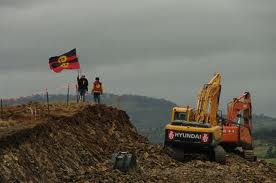
Jim's face says it all -  as the Tasmanian Government arrests protestors and proceeds to build the Brighton by-pass over  mumirimina-kutalayna  heritage along the Jordon River;  kutalayna is a significant link to the Tasmanian Aboriginal community’s history of over 40,000 years (see The Tasmanian Aboriginal Centre's (TAC) Draft Report on the Mumirimina People of the Lower Jordan Valley).


"What kind of things I can share with non Aboriginal people so that they can start  to understand that there is a different way of seeing this world... and their identity cannot be Australian with this country until such time as they get here – they will always be bringing the Northern hemisphere down here and constructing a landscape instead of living in country; landscape is just another  image of the colonial construct... whereas connecting to country goes outside of the colonial construct."  Jim Everett.

"There’s No Such Thing As Post-Colonialism". Jim Everett


This month I was pleased to read Will Owen's blog: Aboriginal Art & Culture: an American eye and his thoughtful response to my documentary Island Home Country: 
Although Island Home Country may have begun as a film about her childhood, Thornley quickly became swept us in the larger questions of history, and then just as quickly in the questions of cultural protocols.  She visits with Jim Everett, with Aunty Phyllis Pitchford, with Tasmanian artists Julie Gough and PennyX Saxon.  Gough in particular raises the issues of image making and image use; Everett and Pitchford urge her to tell her own story and not try to tell the Indigenous stories (although they do contribute their own in snippets throughout the film).  Thus the weave become tangled as Thornley struggles to explore, to learn, and to tell what she learns: to tell a story that is both hers and not hers... She knows as she does so that she is laying a landscape atop country, and knows there is no other way to do it.  It is Jim Everett who speaks the phrase I’ve chosen as the title for this essay: “There’s no such thing as post-colonialism.”  Unless and until the white man leaves and leaves the country to its original inhabitants, whatever remains is still colonial.  There is no escape from history....

Friday, April 15, 2011

save the mumirimina-kutalayna heritage along the Jordon River, Tasmania


Yesterday 15 April 2011 - 25 police arrested 8 camp members: a further 12 people have since been arrested for trepass with no signs of when the conflict will stop. The day before this Jim Everett, respected Tasmanian Aboriginal activist writer, filmmaker, sent an email letter across Australia (and internationally) asking for support to protect this significant Tasmanian Aboriginal site. I post his letter in full and ask all readers to re-post it across their networks. Also visit The Tasmanian Aboriginal Centre's website to learn more about the campaign and give your support.

"Friday 15th April looks like being a very important day in our history and our struggle for respect of who we are, and respect for our culture and heritage. The Tasmanian Government is about to destroy the mumirimina-kutalayna heritage along the Jordon River. Kutalayna holds the Tasmanian Aboriginal community’s history of over 40,000 years. Today, Friday 15th April, our community and our supporters will be at kutalayna to defend our heritage left by our Old People. Constructing a bridge over kutalayna exposes the current Tasmanian Government’s disrespect for our heritage, and our community. Premier Lara Giddings knows that the bridge will destroy the cultural and historical integrity of kutalayna: she dismisses Tasmanian Aboriginal community knowledge about kutalayna boundaries to save 20 seconds of driving time for traffic entering and leaving Hobart. Premier Giddings has a reasonable option to re-route the bypass over the existing bridge to the north, and along and around kutalayna.

Over 40,000 years of Tasmanian Aboriginal heritage, a unique record of human experiences covering at least 2 Ice-ages, is about to be seriously interfered with. Yet we continue Our Struggle for respect and rights inherent in who we are. This has serious consequences for our community. We believe that the police will arrive today to order supporters away from the kutalayna camp, or arrest the people who refuse to leave: supporters and ‘activists’ standing strong as one body to defend kutalayna. Our action will be a passive and send a clear message to the Government that our heritage is not a bargaining tool. Promises of replacing the out-dated Aboriginal Relics Act 1975 with stronger protection laws of our heritage can’t seriously be considered a bargain for agreeing to the destruction of our heritage. Kutalayna, is our oldest ‘library’ book, it holds the stories of our Old People going back over 40,000 years. Our community has suffered many years of destruction to our heritage since Invasion Day: we must make a stand now, leaving it to our grand-children, and theirs’, must not be allowed to happen.

The issue in focus at kutalayna brings a strong opportunity for developing better relationships between the Tasmanian Aboriginal community and white-Tasmania. To make this happen, a genuine demonstration of meaningful progress in respecting our culture and heritage must be shown by the Tasmanian Government.

I know that we all have hoped that after all of the many years we have struggled to be acknowledged as the contemporary Tasmanian Aboriginal Community; with our objective to be genuinely respected for who we are, and with respect of our rights as Aboriginal people: and, after significant agreements have been achieved with previous Tasmanian Governments: our hope has been that we would not again be forced to to protect our heritage from destruction by a Tasmanian Government. The progress we have achieved in relationships between white-Tasmania and our community, encouraged by previous Tasmanian Governments, is being trashed by Premier Giddings’ Government. Whatever active part you play now, urgently, to increase pressure on the Government to stop the threats to kutalayna, may open some positive outcome for our community.

To be short, we are demanding respect by all of Tasmania, represented by the Tasmanian Government, of our rights concerning the protection of our heritage. I ask you to encourage others to come to the kutalayna camp and show support in saving our heritage from this pending threat."